
Feathered Gondwana
Beauty and song, born when Gondwana was joined
Birds are a class of life that I have always found appealing, though I had never put forth much effort towards learning about, or observing, the impressive variety of species of the feathered kind. However, I did have a goal, during most of my adult life, to see parrots in the wild, as they had long been extinct from my home region and I found them to be generally intriguing. That aspiration was technically fulfilled during my Cuba Tour in 02002, and my Madagascar Tour of 02003, though the fleeting sightings I made in those cases were not exactly satisfying. Everything changed on the first days of the Tour of Gondwana, both in the urban zone of Melbourne during the first day after the Pacific crossing, and in Tasmania during the first cycling day, when, without any unusual efforts on my part, beautiful parrots presented themselves in their full glory for my admiration. From that point forward I was hooked, and, I suppose, I now consider myself to be a birdwatcher. That activity was one I had rarely considered in prior years, and certainly would never have thought of doing during a long bicycle tour. Nevertheless, before long I began to consider any day that included the observation of a new bird species as a great day, no matter how heavy traffic was along the way, or how exhausting the terrain had proven to be. By the time I reached the latter Stages, my occasional digressions sneaking across a farmer's field somewhere, in order to get a decent photo of the next bird, began to contribute to my increasingly dawdling cycling pace.
Somewhere along the way, I began to wonder: What should be the signature bird family for Gondwana? That is, what family of birds, not in a strictly taxonomic perspective, of course, would most make one think;
"Ah ha... I must be in the Southern Continents," when one looked up and saw a beautiful member of the group perched on a nearby branch, rock, or other object? Which group would make an effective icon for New Guinea, Madagascar, The Amazon, The Subcontinent, The Outback, and all the other places that are pieces of the once-great landmass? It would need to be a family that was widely distributed across as many of the fragments as possible, but one without much of a presence in North America and Eurasia. So, globally distributed families, ducks, for example, or those with members that migrate in and out of Gondwana, or otherwise travel long distances around the rest of the World, such as terns, or other seabirds, would not be good candidates. The ideal group would have diversified into a large number of species with ranges centered on one of the main Gondwanan landmasses. It is generally assumed that a location with a large number of species from a certain family, while other areas possess fewer varieties, should be considered as the evolutionary "home base" for the family in general. Another requisite aspect would be a generally large population of the individual members of the group, and the frequency that the group as a whole is observed by the people of Gondwana. Finally, the family should possess some sort of outstanding characteristic that makes them worthy of such a lofty position. That could be beautiful plumage, unusual behaviors, intelligence, exquisite songs, or simply an attitude that says, "That's right, I am from Gondwana!" After painstaking observations over dozens of months, I have narrowed the potential candidates down to eight families, or family pairs.
Here are the nominees:
The Bee-Eaters & Motmots
The Bee-Eaters are a family of small insectivorous birds that was unknown to me before the Tour. That changed during a relaxing day off at the Mataranka Homestead in the Northern Territory of Australia, where I enjoyed a little kayaking in the local spring-fed pools and rivers. In doing so, I spent a considerable time being entertained by the precision aerobatics of a pair of Rainbow Bee-Eaters, which were feeding from a tree perch over the water. In addition to their fascinating aerial antics, which are among the best in the bird world, the Bee-Eaters are among the most beautiful small birds I have yet seen. In addition, they politely pose for photographs in a much more accommodating manner, relative to other birds. That species is the only representative I saw in Stage 1, and I believe that there are no others found in Australia or New Guinea. Six more are found in south Asia, of which I saw two. However, it is Africa that is the predominant territory for this group, and that continent holds nineteen species. Of those, I only managed to observe four, though that was not bad, considering the limited area of the continent I visited during the Tour. All of the species I saw scored high in both the beauty and entertainment categories of my evaluations. The Bee-Eaters are not present in South America, however an allied group, the Motmots, can be considered to fill their niche. To me, the superficial similarities are significant, with a similar body and bill shape, dominant colors of olive and chestnut, with blue highlights, tail-racquets or -streamers, and a distinctive flying style used to catch insects. The Motmots are slightly larger than most Bee-Eaters, but otherwise I consider them to be the new world member of that group, and, taxonomically, both are included in the order Coraciiformes.
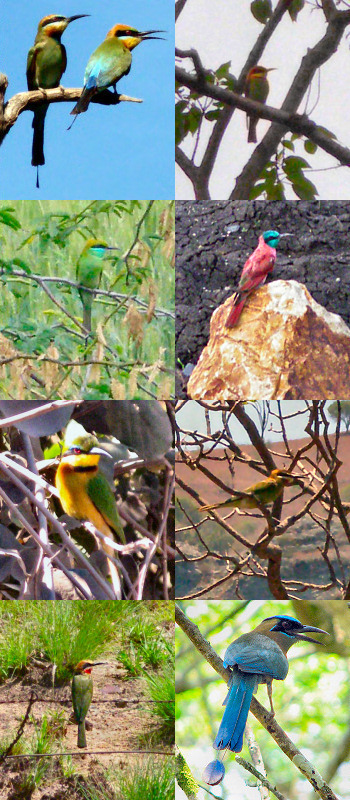
Rainbow Bee-Eater - Aus. | Chestnut-Headed Bee-Eater - Nepal Row 1
Green Bee-Eater - S.Lanka | Northern Carmine Bee Eater - Ethiopia. Row 2
Little Bee-Eater - Tanzania. | Madagascar Bee-Eater - Mad. Row 3
White-Fronted Bee Eater - S. Africa | Lesson's Motmot - Panama Row 4
The Penguins
Penguins score a massive number of points in my little contest by being the only bird, indeed the only animal of any kind, to inhabit the ice-bound Gondwanan fragment of Antarctica, a place that I have always wanted to visit, but was not able to during the Tour. However, I was slightly surprised at the ease at which I was able to see Penguins during three Stages, with India being the only part of Gondwana that is not inhabited or visited by the black-and-white, water-loving birds. My first encounter came on Tasmania when I met the Little Penguin. After that, a considerable length of time passed, not until the final day of Stage 3, before I saw the African Penguin on Boulders Beach, at Cape Town, South Africa. In South America there are a number of species which can be observed, though I only saw three; the Magellanic Penguin on the east coast of Argentina, where I was fortunate to make my observation just before the population had totally gone out to sea, the Humboldt Penguin of Peru, which I saw on an excursion to Islas Ballestas, and the Galapagos Penguin, unique in being the only member of the family to live at the equator and the only one that visits the northern hemisphere. It seems likely that Penguins may have originally evolved on South America and spread to the other continents by circling the Southern Ocean. In fact while I was riding Stage 4, a report was published that presented new discoveries of fossils of a giant penguin which once lived on the Peruvian coast. With the exception of the Little Penguin, all the species that I saw share a similar physical appearance, with a black arch above their white chest, and a variable amount of pink around their bills, and can be assumed to have diverged from a common ancestor. Their unique adaptation to a marine life, with the loss of their flight capabilities, and their charismatic behavior and general friendliness towards humans, make them ideal candidates in my search. On the other hand, the fact that they only live on a few coastal beaches, and leave most of the land area of Gondwana to other creatures, detract from their case.
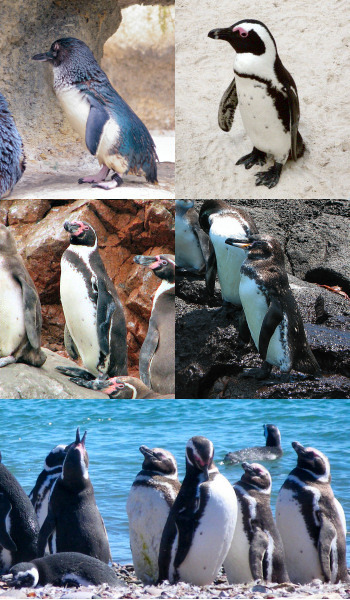
Little Penguin - Aus. | African Penguin - S.Africa Row 1
Humboldt Penguin - Peru | Galapagos Penguin Row 2
Magellanic Penguins - Argentina Row 3
The Kingfishers
My early impressions of the Kingfisher family were based on the two northern-hemisphere species, and my limited experiences with those lead me to believe, incorrectly, that the family was primarily confined to the boreal regions. Nothing could be further from the truth, however, as the Kingfishers are, most definitely, a Gondwanan family. Cousins of the Bee-Eaters, the Kingfishers share with that group a penchant towards colorful plumage, and a pronounced bill which is adeptly used for hunting. However, in contrast to the insectivorous Bee-Eaters, most Kingfishers feed on aquatic life. That fact makes facile observations of the many members of the group practical only near rivers or wetlands. There were plenty of those along my route, including the waterways of Kakadu National Park in Australia, where I saw four new species in a single morning. The other two Australian examples I saw were the forest-dwelling Kookaburras, of which the Laughing Kookaburra, is distinctive for its loud, exotic vocalizations, which have quite possibly been erroneously used as a sound effect in every bad jungle movie ever made. There are a number of species in South Asia, though the White-Breasted Kingfisher is by far the most common in the areas I visited. Africa is the evolutionary stronghold of this group, with nineteen species found on the continent, though I saw only four. In South America, though I tried as best I could, I only managed to observe three of the five local species. However, those three were all very impressive birds, as were the others I encountered along the way.
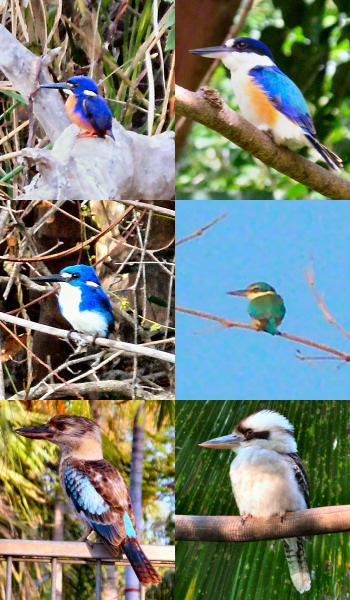
Azure Kingfisher - Australia | Forest Kingfisher - Australia Row 1
Little Kingfisher - Australia | Sacred Kingfisher - Australia Row 2
Blue-Winged Kookaburra - Aus. | Laughing Kookaburra - Aus. Row 3
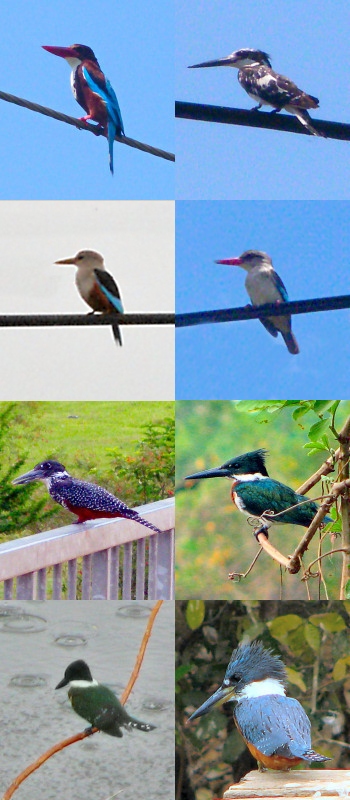
White-Breasted Kingfisher - India | Pied Kingfisher - India Row 1
Grey-Headed Kingfisher - Kenya | Brown-Hooded Kingfisher - S.Afr. Row 2
Giant Kingfisher - Swaziland | Amazon Kingfisher - Brazil Row 3
Green Kingfisher - Colombia | Ringed Kingfisher - Brazil Row 4
The Ratites
In terms of distinctiveness, and evolutionary relevance to Gondwana, it is hard to beat the Ratites. That group, comprised of mostly large, flightless birds occupies a unique niche in the avian world. Strong, powerful, and fleet of foot, these birds do not seem to miss their lack of wings one bit. In Australia, the Emu is the group's main representative, and I had several encounters with the large, and only mildly nervous, birds. Unfortunately, my only sightings of the continent's other members of the group, the Cassowaries, perhaps my favorite member of the family, thanks to their rather outlandish appearance, were of captive birds in Queensland and Papua New Guinea. The most famous, and largest, member of the family, the Ostrich, lives in Africa, of course. There are four sub-species there, of which I saw two. Though it is possible to see an Ostrich in human-dominated areas, a greater likelihood of observing one is found in the many game parks on the continent. However, there is an increasing industry devoted to Ostrich ranching, especially in southern Africa, and those facilities can also make good places to watch the birds. South America possesses two examples, the Lesser and Greater Rheas. As its name suggests, the Lesser Rhea is the smaller of the two, and can be fairly easily seen in the southern part of the continent, especially in southeastern Patagonia. The Greater Rhea lives on the grasslands of eastern South America and my sightings came in the Cerrado of Brazil. India does not currently have a population of any Ratite, though, it did in the past, and that fact reveals the most fascinating and relevant aspect of this group's past.
Specifically, the ancestors of the moderns Ratites lived on Gondwana while it was still joined. Being flightless, the original population became separated and isolated on the various fragments after the supercontinent broke apart, leading to their divergence into the forms we know today. The exact time that these speciations occurred and paths they took are puzzling topics of study for those who work in paleobiology and paleogeology today. One surprising find from those studies is that the Ostrich may have actually been the "Indian Ratite," as its earliest fossils have been found there. Presumably, then, the Ostrich left India, and colonized Africa, after both of those fragments reconnected with Asia. It should be mentioned that there is an additional member of the family that I did not see during the Tour, but which I saw and heard on an earlier tour, the diminutive kiwis of New Zealand. Those islands were also home to one of two types of large Ratites know to have gone extinct in historical times, namely, the Moas. The other example was the "Elephant Bird" of Madagascar, which is believed to be the largest bird to have ever lived, and survived the arrival of humans on the island, possibly until 17th century. If those gargantuan birds still lived today, my tours there would have been even more amazing.
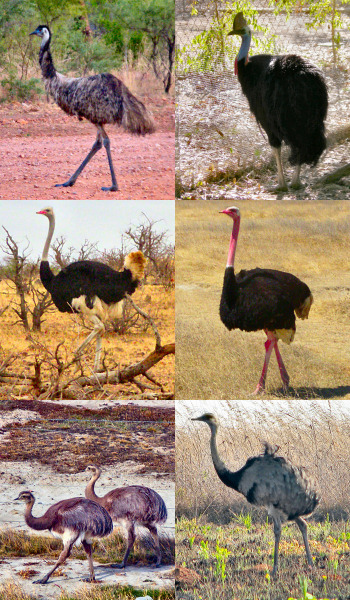
Emu - Australia | Southern Cassowary (captive) - PNG. Row 1
Ostrich - Botswana | Masai Ostrich - Tanzania Row 2
Lesser Rheas - Argentina. | Greater Rhea - Brazil Row 3
The Ibises
Sacred to the ancient Egyptians, Gondwana's earliest civilization, the Ibis family has deep roots in the southern world. I can't exactly say why, but I really like the Ibises. Perhaps it is just the way they strut about, browsing in grasslands or wetlands, and picking up food with their long, decurved bills. They are also large enough that they are easy to spot, though their somewhat nervous demeanor often caused them to retreat to just beyond good-photo range whenever I approached. Though there are some examples found in southern North America and Eurasia, the Ibis family has a true southern heritage. All of the major pieces of Gondwana are well stocked with members of the group, though South America is probably the most diverse region, with eleven species. I did my best to see all of those during Stage 4, and came fairly close. Two species live only in parts of the continent that my route did not reach, namely, the Sharp-Tailed Ibis and the outstandingly beautiful Scarlet Ibis. In fact, I was so intent on seeing the latter, that I planned to add a long tour into Venezuela to my route just to have the opportunity to see some examples in the wild. Unfortunately, that section of the route had to be cut due to time and budget constraints, and so I had to be satisfied with seeing a captive example at the Parque das Aves in Foz do Iguaçu, Brazil. I also thought that I might have failed to see a Green Ibis, and towards the end of the Stage I frantically searched for one, without success. It was not until after the Stage was complete that I realized I had actually seen several in the Brazilian Pantanal, and either had forgotten about the encounter, or never realized it had occurred in the first place. A thirteen-month-long tour is bound to cause such lapses, I suppose.
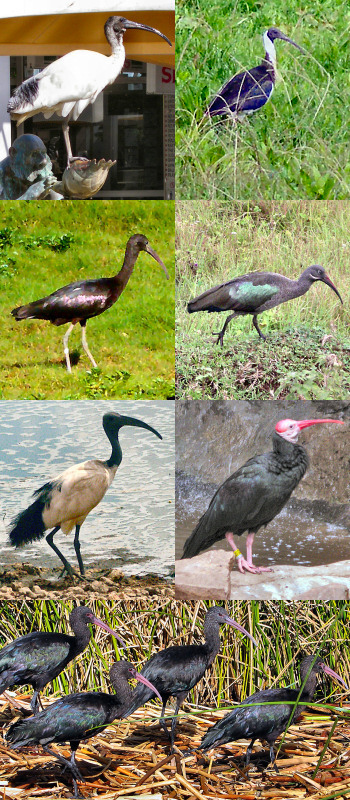
Australian White Ibis - Australia | Straw-Necked Ibis - Aus. Row 1
Glossy Ibis - Aus. | Hadeda Ibis - Ethiopia. Row 2
African Sacred Ibis - Tanzania. | Southern Bald Ibis (captive) - S Afr. Row 3
Puna Ibises - Bolivia. Row 4
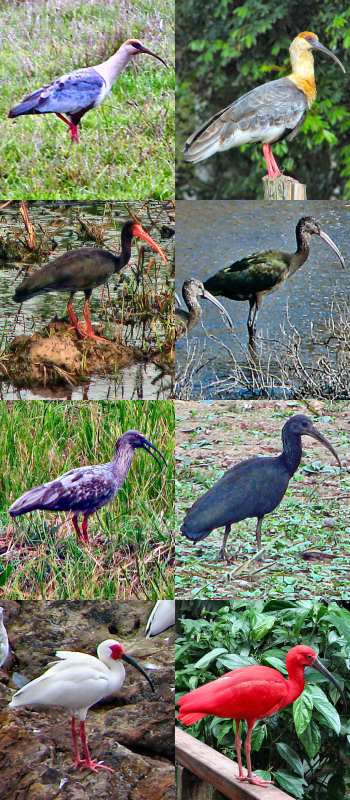
Black-Faced Ibis - Chile | Buff-Necked Ibis - Brazil Row 1
Bare-Faced Ibis - Brazil | White-Faced Ibis - Argentina Row 2
Plumbeous Ibis - Brazil | Green Ibis - Brazil Row 3
White Ibis - Colombia | Scarlet Ibis (captive) - Colombia Row 4
The Sunbirds & Hummingbirds
The next candidate is another pair of unrelated families, one from the eastern hemisphere and one from the western. Though the Sunbirds and Hummingbirds are only distantly related (at the class level,) they share enough physical and behavioral similarities that I will nominate them together. These similarities have probably arisen due to their chosen lifestyle as nectar-feeders, and provide a nice example of convergent evolution. The most noticeable of their common features are small size, a usually long, and often curved, bill, brilliant and often iridescent plumage, and the ability to fly rapidly, precisely, and often without much forward motion. That final aspect results in another, more frustrating, similarity; that both groups are disturbingly difficult to photograph. There is only one species in Australia, the Olive-Backed Sunbird, which I saw on the Queensland Coast. In south Asia, which is home to a number of members of the group, I did observe a few beautiful examples, while I was in the Himalayan foothills, but they proved to be only the briefest of encounters and I was not able to secure a single photo. Africa, on the other hand is the Sunbirds primary domain, and there are at least 86 species living on the continent. My count of seven of those seemed to leave the majority of the family unobserved, but the beauty of the birds that I was able to see more than made up for that. The western hemisphere's counterparts, the Hummingbirds, are well known to residents of the Americas. What I did not realize before the Tour, was that the Hummingbirds of North America, represent only a small fraction of the family, and the real action is below the equator. For well over 200 species reside in South America. That meant that I was able to see them frequently, and in just about all geographic regions and environments. With patience, and more importantly, luck, I did manage to grab a number of fair images of many of the types I saw. However, with so many varieties to choose from, many of which display only slight differences in appearance, I cannot be 100% confident in all of the identifications listed on this page.
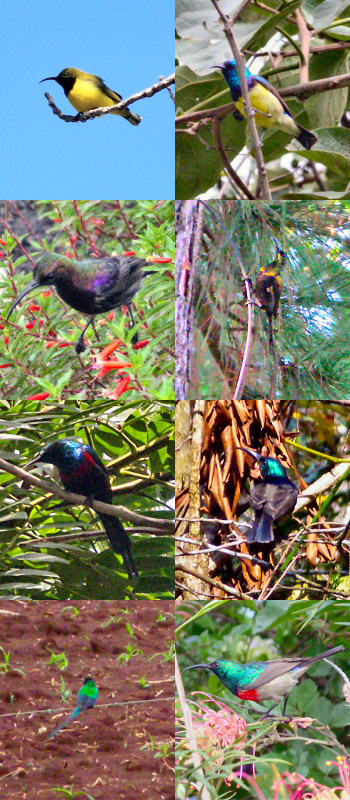
Olive-Backed Sunbird - Aus. | Variable Sunbird - Ethiopia Row 1
Tacazze Sunbird - Ethiopia | Bronzy Sunbird - Rwanda Row 2
Purple-Breasted Sunbird - Rwnd. | Madagascar Green Sunbird - Mad. Row 3
Malachite Sunbird - S Afr. | Greater Double-Collared Sunbird - S Afr. Row 4
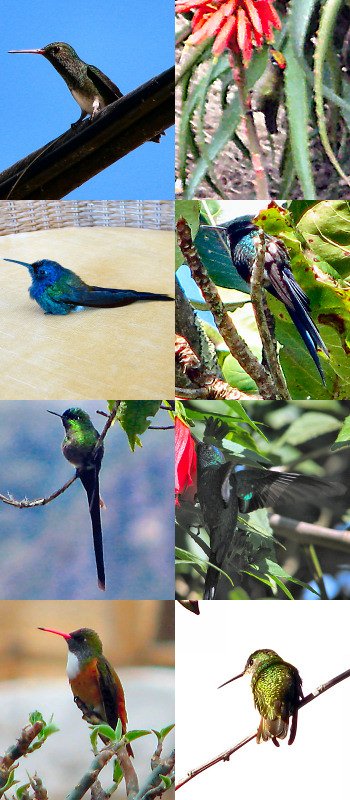
Sapphire-Spangled Emerald - Brz. | Green-Backed Firecrown - Chile Row 1
Swallow-Tailed Hummingbd - Brz. | Long-Tailed Woodnymph - Brazil Row 2
Long-Tailed Sylph - Peru | Violet-Capped Woodnymph - Brazil Row 3
Amazilia Hummingbird - Peru | Green-and-White Hummingbird - Peru Row 4
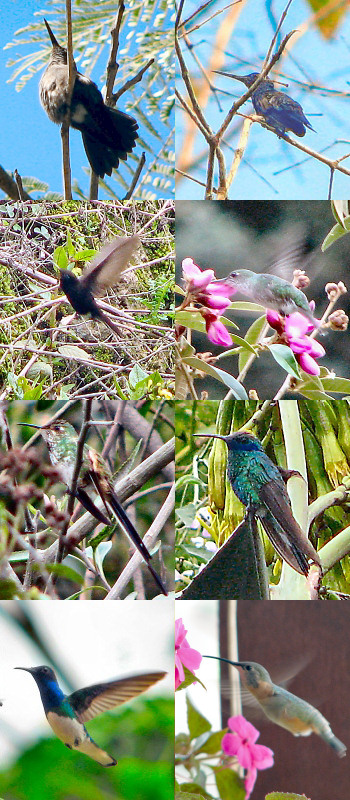
Sombre Hummingbird - Brazil | Blue-Fronted Lancebill - Peru Row 1
Black Metaltail - Peru | White-Bellied Hummingbird - Peru Row 2
Green-Tailed Trainbearer - Ecuador | Sparkling Violetear - Colombia Row 3
White-Necked Jacobin - Colombia | Purple-Collared Woodstar - Peru Row 4
The Hornbills & Toucans
Like the previous candidate, this nominee consists of two very distantly related groups from opposite hemispheres which share a common defining characteristic. Specifically, in the case of both the Hornbills and the Toucans, that is an inordinately large and extended bill. Once again, this demonstrates nicely the concept of convergent evolution, though exactly what particular survival advantage these giant accessories provided to the ancestors of these groups still seems to be poorly understood. The Hornbills are the eastern hemisphere family and though there is one species that is resident on New Guinea, which I was not fortunate enough to observe, it was not until midway through Stage 2 before I saw my first example. The wait was worth it, as my first sighting was the endangered Rufous-Necked Hornbill, an impressive bird that I saw in the forests of Bhutan. Later in the Stage, I encountered a few more species, though the conditions for making observations were never very good during those occasions. Once I reached Africa, the variety and numbers of Hornbills increased dramatically, and I saw a number of different species. It was often hard to see them clearly through the characteristically tangled bush of the region, but with patience I managed a few good shots. In South America, the Toucans take up the charge, but do so in a much more colorful way. With their cartoonish bills and neatly combed, colorful plumage, the birds of that family almost appear to be artificial. Alive they are, however, though it was not until I reached the northern half of the continent that I was able to see any for myself to confirm that fact. When I did come across a wild member of the family, the experience never failed to impress, to be sure. In fact, the Keel-Billed Toucan could possibly be the single most attractive bird I have yet seen.
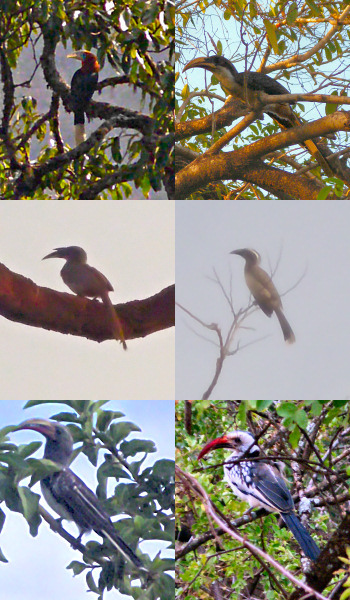
Ruffous-Necked Hornbill - Bhutan | Sri Lanka Grey Hornbill - S.Lanka Row 1
Indian Grey Hornbill - India | African Grey Hornbill - Ethiopia Row 2
Hemprich's Hornbill - Ethiopia | Northern Red-Billed Hornbill - Tanz. Row 3
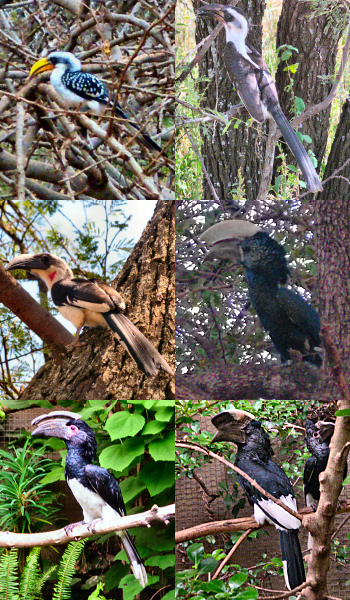
Eastern Yellow-Billed Hornbill - Tanz. | Tanzanian Hornbill - Tanz. Row 1
Von der Decken's Hornbill - Tanz. | Silvery-Cheeked Hornbill - Tanz. Row 2
Trumpeter Hornbill (captive) - Africa | Black-&-White-Casqued
Hornbill (captive) - Africa Row 3
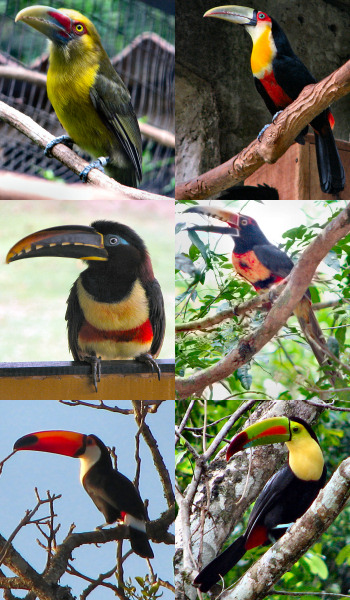
Saffron Toucanet (capt.) - Brz. | Red-Breasted Toucan (capt.) - Brz. Row 1
Chestnut-Eared Aracari - Peru. | Collared Aracari - Colombia Row 2
Tocu Toucan - Brazil. | Keel-Billed Toucan - Colombia Row 3
The Parrots
The Parrots, of course, was where it all began for me. Whether they are referred to as Parakeets, Parrotlets, Amazons, Rosellas, Lories, Conures, Lovebirds, Cockatoos, Macaws, or simply Parrots, it makes little difference to me, I like them all. It was Rainbow Lorikeets that I saw on the first day of the Tour in Melbourne, with Black Cockatoos and Green Rosellas coming next on the first cycling day in Tasmania. From that point forward, some member of the Parrot group was never very far away during the Tour, more or less. Even the frigid, bleak climate of Tierra del Fuego did not dissuade the Austral Parakeet from living there. Of the 350, or so, species of Parrots currently recognized, I was fortunate enough to see 56 in the wild. South America was by far the most productive continent, and it included some of the most attractive and charismatic members of the family. Australia was not far behind, and though it had slightly fewer species overall, it made up for that with truly impressive numbers of individuals. India was rather poorly represented, and Africa was only a little better. That suggests to me that the group has not fared well in those continents since they reconnected with Eurasia, allowing intrusions of northern species into their habitats. Observing Parrots provided some of my most memorable experiences during the Tour, including seeing giant flocks of Black Cockatoos (and white ones as well) in Australia, and my first sighting of Blue-and-Yellow Macaws flying right over my head in the savannas of Brazil. The fact that almost 300 species remain unseen by me, is a nagging calling that may prompt me to do another tropical tour in the future, while seeing many of those species in the wild is still possible. Most Americans probably don't realize that the United States once was home to two native Parrot species, both of which are now extinct. I have a reproduction of Audubon's Carolina Parrot print hanging in my home as a reminder of what we have lost.
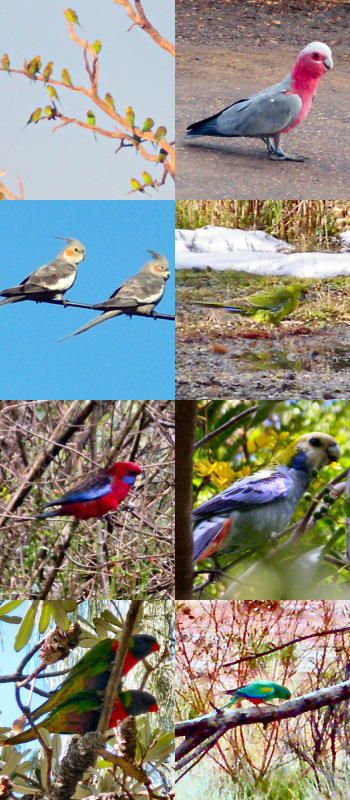
Budgerigars - Australia | Galah - Australia Row 1
Cockatiels - Australia | Green Rosella - Australia Row 2
Crimson Rosella - Australia | Pale-Headed Rosella - Australia Row 3
Rainbow Lorikeets - Australia | Mulga Parrot - Australia Row 4
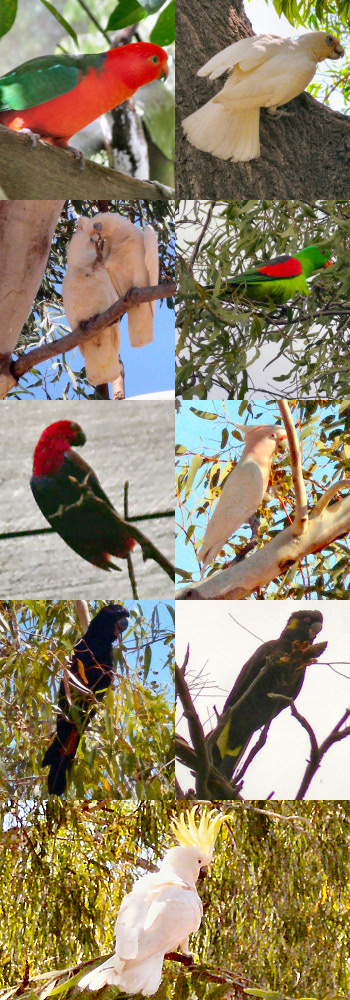
King Parrot (captive) - Australia | Little Corella - Australia Row 1
Western Corellas- Australia | Red-Winged Parrot - Australia Row 2
Eclectus Parrot (captive) - Aus. | Major Mitchell's Cockatoo -Aus. Row 3
Red-Tailed Black Cockatoo - Au | Yellow-Tailed Black Cockatoo - Au Row 4
Sulfur-Crested Cockatoo - Aus Row 5
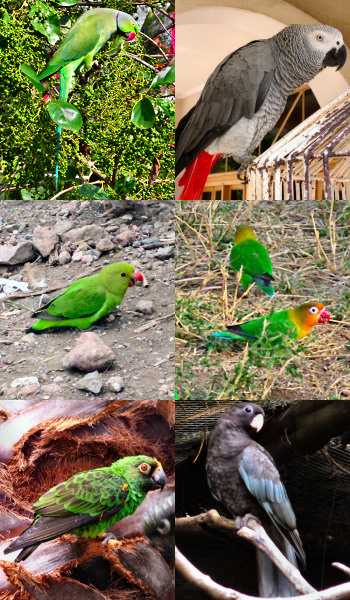
Rose-Ringed Parakeet - India | African Grey Parrot (captive) - Rwd. Row 1
Black-Winged Lovebird - Ethiopia | Fischer's Lovebird - Tanz. Row 2
Jardines Parrot (captive) - Afr. | Lesser Vasa Parrot (captive) - Mad. Row 3
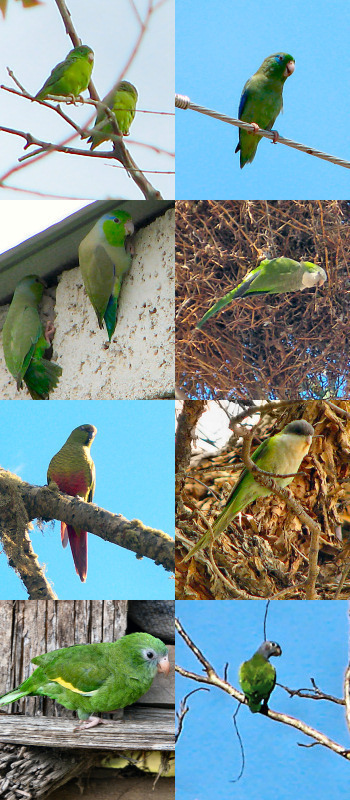
Dusky-Billed Parrotlet - Peru | Spectacled Parrotlet - Colombia Row 1
Pacific Parrotlet - Ecuador | Monk Parakeet - Argentina Row 2
Austral Parakeet - Argentina | Grey-Hooded Parakeet - Bolivia Row 3
White-Winged Parakeet - Peru | Blue Headed Parrot - Colombia Row 4
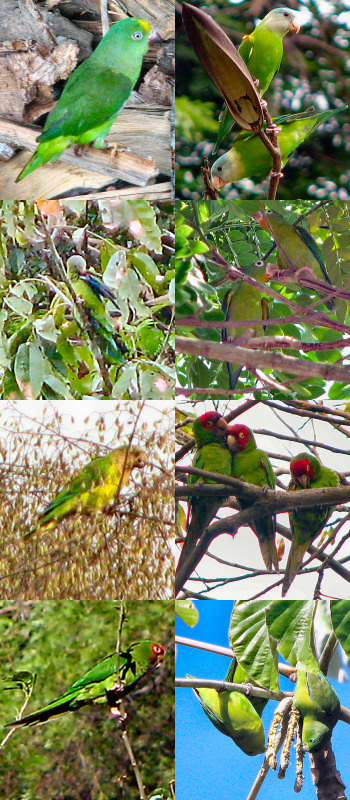
Tui Parakeet - Peru | Grey-Cheeked Parakeet - Ecuador Row 1
Cobalt-Winged Parakeet - Peru | Orange-Chinned Parakeet - Colom. Row 2
Dusky-Headed Parakeet - Colom. | Red-Masked Parakeet - Peru Row 3
Mitred Parakeet - Peru | Plain Parakeet - Brazil Row 4
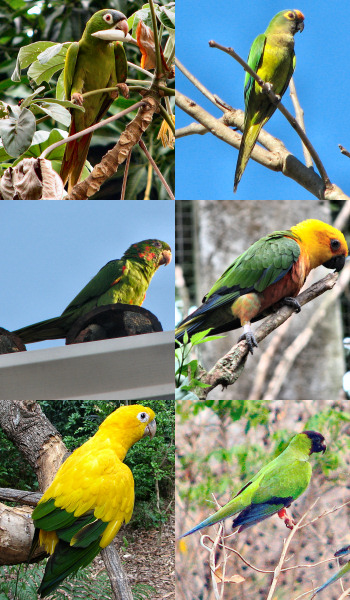
Blue-Crowned Parakeet - Brazil | Peach-Fronted Parakeet - Brazil Row 1
White-Eyed Parakeet - Brazil | Jandaya Parakeet (captive) - BrazilRow 2
Golden Parakeet (captive) - Brazil | Nanday Parakeet - Brazil. Row 3
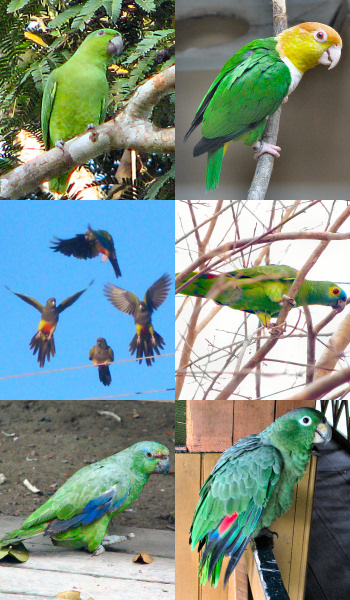
Short-Tailed Parrot - Peru | White-Bellied Parrot (captive) - Brz. Row 1
Burrowing Parrots - Argentina | Blue-Fronted Amazon - Brz. Row 2
Festive Amazon - Peru | Mealy Amazon - Peru Row 3
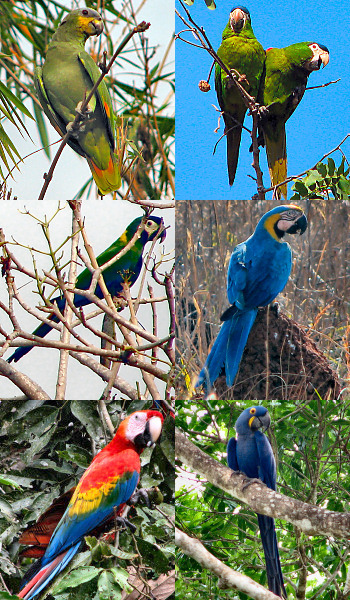
Orange-Winged Amazon - Colom. | Red-Shouldered Macaw - Brazil Row 1
Golden-Collared Macaw - Brazil | Blue & Yellow Macaw - Brazil Row 2
Scarlet Macaw - Peru | Hyacinth Macaw - Brazil Row 3
The Winner Is?
So, which birds will forever, at least for me, be linked to the lands of the former supercontinent of Gondwana, and stand as its representative for future generations? It is hard to discount the uniqueness of the flightless birds, the Penguins and the Ratites, which exist nowhere else on Earth. On the other hand, the superlative beauty of the small birds, the Hummingbirds/Sunbirds and the Bee-Eaters cannot be denied. The charisma, dignified countenance, and widespread distribution across Gondwana of the Ibises and Kingfishers speak well for those groups as well. Though what family could be more instantly recognizable that then colossal-billed Hornbills/Toucans? And, of course, there are the Parrots with all of their playfulness, intelligence, and color, which make them a great all-around choice. Which, then, should it be?
As you may have guessed, I can't decide. Perhaps that is for the best. For now, as is only befitting an issue of such immense global importance, I will leave the question open for future debate.
Previous | Next
Main Index | Pre-Tour Index
Post-Tour Index | Articles Index
Slideshows
Main Index Pre-Tour Post-Tour Articles Previous Next |
The Tour of Gondwana
Bird List
The birds shown on this page represent only about a quarter of all the species I saw for the first time during the Tour. The remainder included many beautiful and interesting species, and the complete list is given below. Considering that I was a complete birding novice at the time, and was also limited by the usual constraints of a bicycle tour, which was, of course, my primary activity, I think that I did rather well. I include on the list only those birds which I could positively identify, preferably with a good photo. The latter requirement was not always easy, as the light, portable cameras I prefer for cycling would be sneered at by any serious birder. Nevertheless, with a large dose of patience, a little practice, and, most importantly, several hours a day out in the natural world, I was able to achieve much more than I might have expected, with well over 700 species identified.
As far as ease of observations was concerned, here is the breakdown for number of kilometers of cycling per new bird species for the five Stages:
~ Stage 2: 366 km/species
~ Stage 5: 175 km/species
~ Stage 1: 130 km/species
~ Stage 3: 101 km/species
~ Stage 4: 79 km/species
Asia proved to be the least successful Stage for me, with a much longer distance needed to see a new species. While there are certainly plenty of nice birds there, their ranges have been so diminished by the ponderous human presence along my route that I was not able to observe very many of them. Stage 5 required a surprisingly long distance per species, despite Central America being a hotbed of birding. That largely resulted from the similarities of the avifauna of that region with the rest of the neotropics, meaning that many of the birds I saw there were already counted in the Stage 4 tally. Stage 1 in Australia would have ranked near the best of the Stages, were it not for the long, uniform distances of the Outback, which provided relatively few sightings of new species. Africa surprised me quite a bit with regards to its ease of observations, though that factor was not very uniform throughout the Stage. However, Stage 4 in South America, blew all the others off the map with a mere 79 kilometers required, on average, to spot a new species. Meaning that, in effect, I saw more than one new bird species for every cycling day, a truly satisfying state of affairs.
Stage 1
(128 )
Emu
Black Swan
Green Pygmy Goose
Magpie Goose
Plummed Whistling-Duck
Wandering Whistling-Duck
Radjah Shelduck
Scrub Turkey
Orange-Footed Scrubfowl
White-Headed Stilt
Red-Capped Plover
Lesser Sand-Plover
Red-Kneed Dotterel
Bar-Tailed Godwit
Great Knot
Greater Crested Tern
Lesser Crested Tern
Franklin's Gull
Silver Gull
Pacific Gull
Pied Oystercatcher
Sooty Oystercatcher
Masked Lapwing
Comb-Crested Jacana
Little Penguin
Australian Pelican
Australasian Darter
Great Cormorant
Litttle Black Cormorant
Little Pied Cormorant
Pied Cormorant
Australian White Ibis
Straw-Necked Ibis
Glossy Ibis
Royal Spoonbill
Cattle Egret
Little Egret
Great Egret
Nankeen Night Heron
Pied Heron
White-Faced Heron
White-Necked Heron
Striated Heron
Black-Necked Stork
White-Bellied Sea Eagle
Wedge Tail Eagle
Brown Kite
Black-Shouldered Kite
Brahminy Kite
Black Falcon
Brolga
Eurasian Coot
Buff-Banded Rail
Brown Cuckoo Dove
Peaceful Dove
Common Emerald Dove
Bar Shouldered Dove
Spinifex Pigeon
Crested Pigeon
Budgerigar
Galah
Cockatiel
Crimson Rosella
Pale-Headed Rosella
Green Rosella
Rainbow Lorikeet
Scaly-Breasted Lorikeet
Major Mitchell's Cockatoo
Red-Tailed Black Cockatoo
Yellow-Tailed Black Cockatoo
Sulfur-Crested Cockatoo
Little Corella
Mulga Parrot
Red-Winged Parrot
Brush Cuckoo
Forest Kingfisher
Little Kingfisher
Sacred Kingfisher
Azure Kingfisher
Blue-Winged Kookaburra
Laughing Kookaburra
Rainbow Bee-Eater
Superb Lyrebird
Red-Backed Fairy-Wren
Lewin's Honeyeater
Black-Chinned Honeyeater
Scarlet Honeyeater
Blue-Faced Honeyeater
Brown Honeyeater
Rufous-Banded Honeyeater
White-Throated Honeyeater
Gray-Headed Honeyeater
Grey-Fronted Honeyeater
White-Plumed Honeyeater
Singing Honeyeater
Helmeted Friarbird
Silver-Crowned Friarbird
Yellow Throated Miner
White-Bellied Cuckoo-Shrike
Black-Faced Cuckoo-Shrike
Grey Shrike Thrush
Regent Whistler
Rufous Whistler
Crested Shrike-Tit
Australasian Figbird
Olive-Backed Oriole
Australian Magpie
Grey Butcherbird
White-Breasted Woodswallow
Black-Faced Woodswallow
Great Woodswallow
Leaden Flycatcher
Shining Flycatcher
Magpie-Lark
Apostlebird
Forest Raven
Australian Raven
Torresian Crow
Great Bowerbird
Gray-Crowned Babbler
Scarlet Robin
Buff-Sided Robin
Welcome Swallow
White-Bellied Bushchat
Willie Wagtail
Double-Barred Finch
Crimson Finch
Zebra Finch
Olive-Backed Sunbird
Stage 2
(48)
Ruddy Shelduck
Peacock
Black-Winged Stilt
Red-Wattled Lapwing
Little Grebe
Little Cormorant
Javan Pond Heron
Asian Openbill
Lesser Adjutant
Black-Winged Kite
Eurasian Griffon
Sarus Crane
Black-Necked Crane
Red-Collared Dove
Orange-Breasted Green Pigeon
Rose-Ringed Parakeet
Blossom-Headed Parakeet
Chestnut-Breasted Malkoha
Barn Owl
Pied Kingfisher
White-Breasted Kingfisher
Rufous-Necked Hornbill
Indian Grey Hornbill
Sri Lanka Grey Hornbill
Little Green Bee-Eater
Chestnut Headed Bee-Eater
Dollarbird
Indian Roller
Hoopoe
Greater Flameback
Long-Tailed Minivet
Black-Naped Oriole
Black-Headed Oriole
Black Drongo
Bronzed Drongo
Common Raven
Rufous Treepie
Yellow-Billed Blue Magpie
Eurasian Magpie
Stripe-Throated Bulbul
Red-Vented Bulbul
White-Capped Redstart
Chestnut-Bellied Rock-Thrush
Siberian Stonechat
Oriental Magpie-Robin
Common Myna
White Wagtail
Purple Sunbird
Stage 3
(142)
Ostrich
Egyptian Goose
Spur-Winged Goose
Knob-Billed Duck
White-Faced Whistling Duck
Cape Shoveler
Helmeted Guinea Fowl
Vulturine Guinea Fowl
White-Fronted Plover
Cape Gull
Blacksmith Lapwing
African Penguin
Great White Pelican
Hammerkopf
White-Breasted Cormorant
Crowned Cormorant
African Darter
Hadeda Ibis
African Sacred Ibis
Goliath Heron
Grey Heron
Purple Heron
Black-Headed Heron
African Openbill
Maribou Stork
White Stork
Yellow-Billed Stork
Greater Flamingo
African Crowned Eagle
Long-Crested Eagle
Black Kite
Augur Buzzard
Secretary Bird
Egyptian Vulture
White-Backed Vulture
Rüppell's Vulture
Moorhen
Red-Knobbed Coot
Crowned Crane
Kori Bustard
Black-Bellied Bustard
African Mourning Dove
Dusky Turtle Dove
Cape Turtle Dove
Lemon Dove
Laughing Dove
Speckled Pigeon
Black-Winged Lovebird
Fischer's Lovebird
White-Bellied Go-Away Bird
White-Browed Coucal
Malagasy Coucal
Madagascar Lesser Cuckoo
Red-Breasted Cuckoo
Grey-Headed Kingfisher
Brown-Hooded Kingfisher
Giant Kingfisher
African Grey Hornbill
Northern Red-Billed Hornbill
Hemprich's Hornbill
Eastern Yellow-Billed Hornbill
Silvery-Cheeked Hornbill
Tanzanian Red-Billed Hornbill
Von der Decken's Hornbill
Northern Carmine Bee-Eater
Ethiopian Bee-eater
Madagascar Bee-Eater
Little Bee-Eater
White-Fronted Bee-Eater
Purple Roller
Broad-Billed Roller
Lilac-Breasted Roller
Nubian Woodpecker
Speckled Mousebird
Crested Drongo
African Paradise-Flycatcher
Northern White-Crowned
Shrike
Southern White-Crowned
Shrike
Crimson Shrike
Somali Fiscal
Northern Fiscal
Southern Fiscal
Long-Tailed Fiscal
White-Necked Raven
Thick-Billed Raven
Stresemann's Bush Crow
Greater Striped Swallow
Pearl-Breasted Swallow
Somali Bulbul
Madagascar Black Bulbul
Dark-Capped Bulbul
Montane White-Eye
Forest Rock-Thrush
Benson's Rock-Thrush
White-Browed Robin-Chat
Madagascar Stonechat
Sickle-Winged Chat
Mocking Cliff-Chat
Madagascar Magpie-Robin
Silverbird
Abyssinian Thrush
Red-Billed Oxpecker
Yellow-Billed Oxpecker
Greater Blue-Eared Starling
Superb Starling
White-Crowned Starling
Golden-Breasted Starling
Red-Winged Starling
Ruppell's Starling
Hildebrandt's Starling
Swainson's Sparrow
Swahili Sparrow
African Pied Wagtail
Madagascar Wagtail
Yellow-Throated Longclaw
Red-Cheeked Cordonbleu
Red-Billed Firefinch
Lesser Masked Weaver
Village Weaver
White-Headed Buffalo-Weaver
Orange Weaver
Baglafecht Weaver
Spectacled Weaver
Southern Brown-Throated Weaver
Cape Weaver
Northern Red Bishop
Southern Red Bishop
Yellow Bishop
Yellow-Mantled Widowbird
Long-Tailed Widowbird
Straw-Tailed Wyhdah
Pin-Tailed Whydah
White-Bellied Canary
Brown-Rumped Seedeater
Variable Sunbird
Tacazze Sunbird
Eastern Violet-Backed
Sunbird
Purple-Breasted Sunbird
Bronzy Sunbird
Madagascar Green Sunbird
Malachite Sunbird
Greater Double-Collared
Sunbird
Stage 4
(355)
Lesser Rhea
Greater Rhea
Andean Tinamou
Black-Necked Swan
Coscoroba Swan
Magellan Goose
Andean Goose
Ashy-Headed Goose
Kelp Goose
Southern Screamer
Horned Screamer
Crested Duck
Puna Teal
Yellow-Billed Pintail
Andean Duck
Flying Steamer Duck
Magellanic Steamer Duck
Black-Bellied Whistling-Duck
Muscovy Duck
Silver Teal
Speckled Teal
Cinnamon Teal
Chiloe Wigeon
Chaco Chachalaca
Rusty-Margined Guan
White-Necked Stilt
Rufous-Chested Dotterel
Collared Plover
American Golden Plover
Killdeer
South American Tern
Royal Tern
Inca Tern
Yellow-Billed Tern
Large-Billed Tern
Gull-Billed Tern
Black Skimmer
Dolphin Gull
Andean Gull
Brown-Hooded Gull
Grey-Headed Gull
Kelp Gull
Belcher's Gull
Blackish Oystercatcher
American Oystercatcher
Magellanic Oystercatcher
Andean Lapwing
Southern Lapwing
Wattled Jacana
Colombian Wattled Jacana
Spotted Sandpiper
Baird's Sandpiper
Lesser Yellowlegs
Willet
Fuegian Snipe
Great Grebe
White-Tufted Grebe
Pied-Billed Grebe
Magellanic Penguin
Humbolt Penguin
Brown Pelican
Peruvian Pelican
Anhinga
Neotropical Cormorant
Imperial Cormorant
Red-Legged Cormorant
Guanay Cormorant
Rock Shag
Cape Gannet
Masked Booby
Peruvian Booby
Bare-Faced Ibis
Black-Faced Ibis
Buff-Necked Ibis
White-Faced Ibis
Puna Ibis
Plumbeous Ibis
Green Ibis
White Ibis
Roseate Spoonbill
Capped Heron
Rufescent Tiger Heron
Cocoi Heron
Whistling Heron
Black Crowned Night Heron
Yellow-Crowned Night Heron
Tricolored Heron
Little Blue Heron
Snowy Egret
Reddish Egret
Maguari Stork
Wood Stork
Jabiru
Chilean Flamingo
Solitary Eagle
Snail Kite
Grey-Headed Kite
Pearl Kite
Southern Crested Caracara
Northern Crested Caracara
Chimango Caracara
Yellow-Headed Caracara
Mountain Caracara
Variable Hawk
Plumbeous Hawk
Black-Collared Hawk
Great Black Hawk
Roadside Hawk
Savanna Hawk
Black-Chested Buzzard-Eagle
American Kestrel
Bat Falcon
Black Vulture
Andean Condor
Andean Coot
Red-Fronted Coot
Common Gallinule
Red-Legged Seriema
Limpkin
Pinnated Bittern
Sunbittern
Plumbeous Rail
Giant-Wood Rail
Plumbeous Pigeon
Picui Ground-Dove
Ruddy Ground Dove
Scaled Dove
Eared Dove
White-Winged Dove
Bare-Faced Ground-Dove
Croaking Ground-Dove
Dusky-Billed Parrotlet
Pacific Parrotlet
Spectacled Parrotlet
Orange-Chinned Parakeet
Monk Parakeet
Mountain Parakeet
Austral Parakeet
Grey-Hooded Parakeet
White-Winged Parakeet
Yellow-Chevroned Parakeet
Slender-Billed Parakeet
Mitred Parakeet
Scarlet-Fronted Parakeet
Red-Masked Parakeet
Tui Parakeet
Grey-Cheeked Parakeet
Dusky-Headed Parakeet
Cobalt-Winged Parakeet
Plain Parakeet
Blue-Crowned Parakeet
Nanday Parakeet
White-Eyed Parakeet
Peach-Fronted Parakeet
Burrowing Parrot
Yellow-Faced Parrot
Short-Tailed Parrot
Blue-Fronted Amazon
Mealy Amazon
Festive Amazon
Yellow-Crowned Amazon
Orange-Winged Amazon
Hyacinth Macaw
Red-Shouldered Macaw
Blue and Yellow Macaw
Scarlet Macaw
Golden-Collared Macaw
Guira Cuckoo
Squirrel Cuckoo
Greater Ani
Smooth-Billed Ani
Hoatzin
Burrowing Owl
Sand-Colored Nighthawk
Long-Tailed Woodnymph
Sapphire-Spangled Emerald
Violet-Capped Wood Nymph
Swallow-Tailed Hummingbird
Green-Backed Firecrown
Long-Tailed Sylph
Sombre Hummingbird
Blue-Fronted Lancebill
Green-Tailed Trainbearer
Green-and-White
Hummingbird
White-Bellied Hummingbird
Amazilia Hummingbird
Purple-Collared Woodstar
Black Metaltail
Sparkling Violetear
Great Dusky Swift
Amazon Kingfisher
Ringed Kingfisher
White-Eared Jacamar
Black-Fronted Nunbird
White-Eared Puffbird
Scarlet-Crowned Barbet
Tocu Toucan
Chestnut-Eared Aracari
Campo Flicker
Northern Andean Flicker
Southern Andean Flicker
Blonde-Crested Woodpecker
Red-Crowned Woodpecker
Lineated Woodpecker
Yellow Tufted Woodpecker
Striped Woodpecker
White Woodpecker
Collared Trogon
Sierran Elaenia
Fork-Tailed Flycatcher
Vermillion Flycatcher
Pale-Edged Flycatcher
Dusky-Capped Flycatcher
Short-Crested Flycatcher
Great Kiskadee
Lesser Kiskadee
Tropical Kingbird
Cattle Tyrant
Masked Water-Tyrant
Fire-Eyed Diucon
White Monjita
White-Rumped Monjita
White-Headed Marsh Tyrant
Streamer-Tailed Tyrant
Plum-Throated Cotinga
Bare-Headed Fruit Crow
Rufous Hornero
Pale-Legged Hornero
Common Miner
Cinnamon-Throated
Woodcreeper
Brown Cacholote
Rufous Cacholote
Grey-Flanked Cinclodes
Dark-Bellied Cinclodes
Cream-Winged Cinclodes
Parker's Spinetail
Thorn-Tailed Rayadito
Variable Antshrike
Purplish Jay
Curl-Crested Jay
White-Tailed Jay
Plush-Crested Jay
White-Winged Swallow
Blue-and-White Swallow
Gray-Breasted Martin
Brown-Chested Martin
Black-Capped Donacobius
Austral Thrush
Black-Billed Thrush
Chiguanco Thrush
Great Thrush
Rufous-Bellied Thrush
White-Necked Thrush
Chalk-Browed Mockingbird
Long-Tailed Mockingbird
Brown-Backed Mockingbird
Thrush-Like Wren
House Wren
House Sparrow
Hooded Siskin
Black Siskin
Violaceous Euphonia
Chestnut-Bellied Euphonia
Peruvian Meadowlark
Long-Tailed Meadowlark
Eastern Meadowlark
Russet-Backed Oropendola
Dusky-Green Oropendola
Crested Oropendola
Red-Rumped Cacique
Yellow-Rumped Cacique
Screaming Cowbird
Bay-Winged Cowbird
Shiny Cowbird
Giant Cowbird
Austral Blackbird
Scrub Blackbird
Yellow-Hooded Blackbird
Red-Breasted Blackbird
Great-Tailed Grackle
Brown-and-Yellow Marshbird
Yellow-Rumped Marshbird
White-Edged Oriole
Yellow Oriole
Orange-Backed Troupial
Slate-Throated Redstart
Masked Crimson Tanager
Sayaca Tanager
Brazilian Tanager
Red-Necked Tanager
Green Headed Tanager
Golden-Chevroned Tanager
Brown Tanager
Olive-Green Tanager
Saffron-Crowned Tanager
Silver-Beaked Tanager
Blue-Grey Tanager
Ruby-Crowned Tanager
Red-Crested Cardinal
Yellow-Billed Cardinal
Bananaquit
Blue Dacnis
Plain-Colored Seedeater
Chestnut-Bellied Seedeater
Tawny-Bellied Seedeater
Band-Tailed Seedeater
Patagonian Sierra-Finch
Gray-Hooded Sierra-Finch
Mourning Sierra-Finch
Great Pampa-Finch
Cinereous Finch
Red Pileated Finch
Saffron Finch
Black-Throated Saltator
Southern Yellow Grosbeak
Black-Backed Grosbeak
Bright-Rumped Yellow-Finch
Rufous-Collared Sparrow
Galapagos
American Flamingo
White-Cheeked Pintail
Blue-Winged Teal
Semipalmated Plover
Black-Bellied Plover
Ruddy Turnstone
Brown Noddy
Swallow-Tailed Gull
Lava Gull
Western Sandpiper
Solitary Sandpiper
Sanderling
Red-Necked Phalarope
Whimbrel
Wandering Tattler
Blue-Footed Booby
Nasca Booby
Galapagos Shearwater
Band-Rumped Storm Petrel
Galapagos Storm Petrel
Elliott's Storm Petrel
Galapagos Penguin
Great Frigatebird
Great Blue Heron
Lava Heron
Galapagos Dove
Galapagos Flycatcher
Galapagos Mockingbird
Yellow Warbler
Small Ground Finch
Medium Ground Finch
Large Ground Finch
Cactus Ground Finch
Large Tree Finch
Vegetarian Finch
Stage 5
(56)
Mottled Duck
Ocellated Turkey
Plain Chachalaca
Wilson's Plover
White-Rumped Sandpiper
Sandwich Tern
Common Tern
Laughing Gull
Magnificent Frigatebird
Green Heron
Gray Hawk
Purple Gallinule
Inca Dove
Orange-Fronted Parakeet
Olive-Throated Parakeet
Blue-Headed Parrot
Red-Lored Parrot
White-Fronted Parrot
White-Necked Jacobin
Cinnamon Hummingbird
Broad-Tailed Hummingbird
Green Kingfisher
Turquoise-Browed Motmot
Lesson's Motmot
Rufous-Tailed Jacamar
Chestnut-Mandibled Toucan
Keel-Billed Toucan
Collared Aracari
Hoffman's Woodpecker
Yucatan Woodpecker
Pale-Billed Woodpecker
Cassin's Kingbird
White-Ringed Flycatcher
Yellow-Crowned Tyrannulet
Rose-Throated Becard
Common Tody-Flycatcher
Mountain Elaenia
Plain Xenops
Chihuahuan Raven
Woodhouse's Scrub Jay
Yucatan Jay
Brown Jay
White-Throated Magpie Jay
Cave Swallow
Barn Swallow
House Finch
Montezuma Oropendola
Yellow-Tailed Oriole
Yellow-Backed Oriole
Nicaraguan Grackle
Scarlet-Rumped Tanager
Crimson-Backed Tanager
White-Collared Seedeater
Blue-Black Grassquit
Pyrrhuloxia
Phainopepla